
HACE is working to make Child Labour an unquestioned global priority.

Navigate complex supply chain and portfolio risks through HACE’s ecosystem of technical tools, featuring our global Child Labour Benchmark, extensive risk datasets, and expert bespoke consultancy.
The HACE Child Labour Network offers a collaborative space for organisations of all types to come together and share best practice, gain actionable insights and influence the global approach to Child Labour.
138 million children are still in exploitative or hazardous work.
which is equivalent to…
48% of the population of the United States
〰️
8x the population of London
〰️
1,777x the capacity of Wembley Stadium
〰️
48% of the population of the United States 〰️ 8x the population of London 〰️ 1,777x the capacity of Wembley Stadium 〰️
-
Federal fines for US Child Labour violations quadrupled from $4 million to $15 million between 2022 and 2023.
A HACE survey found 87% of consumers associated specific brands, such as Nike, with Child Labour due to historical scandals.
According to BCG, 70% of consumers are sceptical of corporate claims about taking action to address sustainability issues.
54.5% shareholder support for a 2024 Tyson Foods Child Labour resolution demonstrates investor concern.
-
An ILO estimate suggests eliminating Child Labour could generate a $5.1 trillion economic benefit by 2030 globally.
Ethical consumer spending grew 9.2% since 2013, outstripping non-sustainable products by three times.
The ethical market's CAGR of 12.4% is much higher than the 4% rate for the conventional market.
Tony's Chocolonely reached €200.1 million revenue in 2024, demonstrating that ethical sourcing can be commercially successful.
The new standard in corporate Child Labour governance.
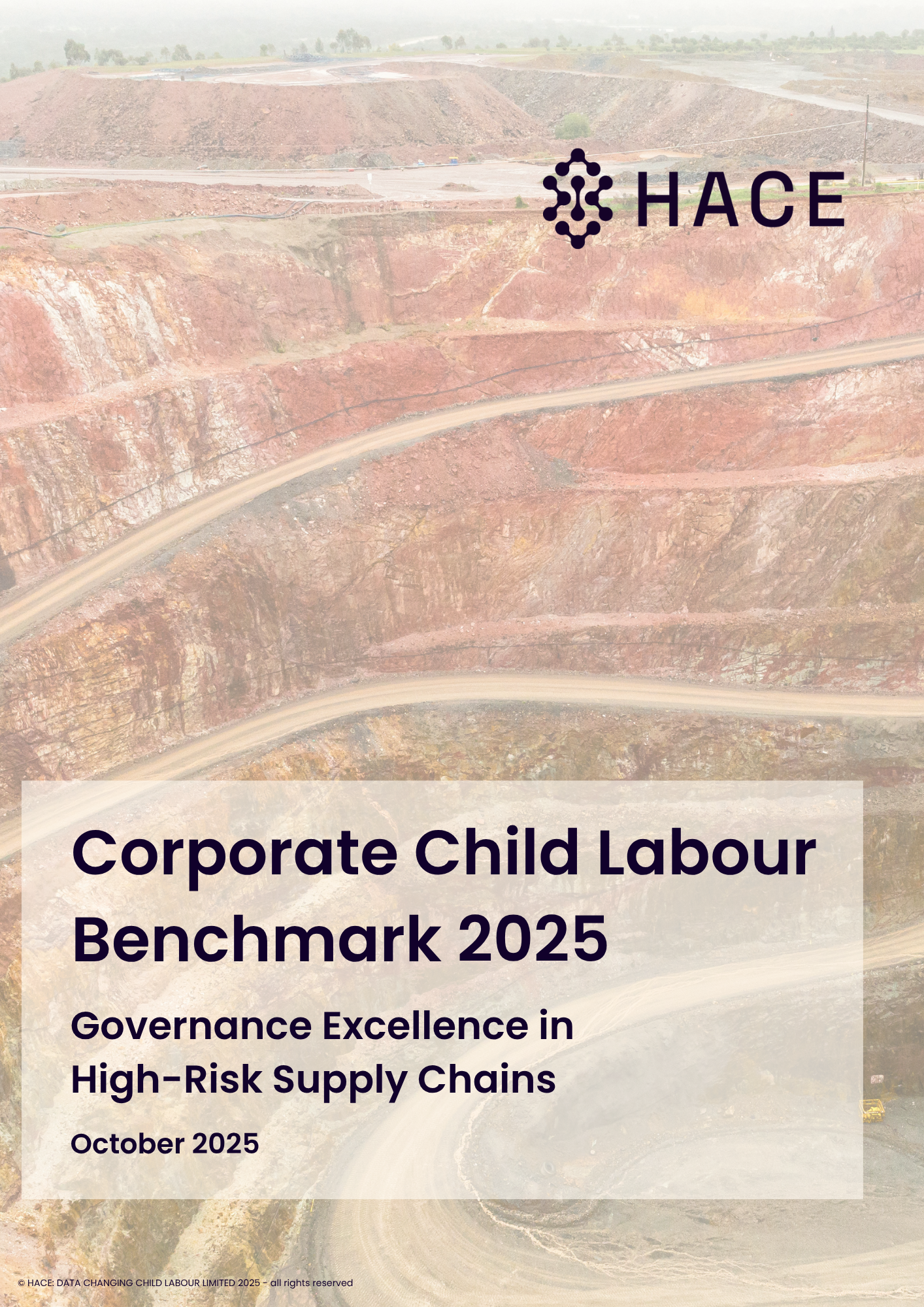
HACE’s 2025 Corporate Child Labour Benchmark sets the new standard for corporate governance, identifying and acknowledging the highest-performing public companies operating in supply chains at risk of Child Labour. As a data-driven and open-source tool, the Benchmark empowers businesses and investors to drive meaningful progress, while also providing a transparent resource for consumers and the public to understand what "good looks like" in this complex area.
By objectively scoring a company's public governance and systems, the Benchmark provides a metric that moves beyond mere compliance to spotlight truly excellent and innovative approaches to addressing Child Labour. It allows companies to share best practices across sectors, encourages transparent disclosure, and helps responsible leaders translate ethical commitment into measurable, positive change for children and communities worldwide.